4-Letter Domains as Startup Names: Why Founders Pay a Premium
Founders routinely pay a premium for 4-letter domains as startup names, and it is not vanity. A four-letter .com solves a cluster of practical problems — memorability, spoken sharing, app-era design constraints, email brevity — that longer names handle badly. Here is why the short-name premium exists and how to think about it if you are naming a company.
Short names survive the app era
Modern brands live in constrained spaces. An app icon shows a handful of characters. A push notification truncates. A slide header, a conference badge, a favicon, a social handle — all reward brevity. A four-letter name fits every one of these surfaces without abbreviation, and it never gets shortened into something you did not choose.
This matters more than it did in the desktop web era. When your product's first impression is a 1024-pixel icon squeezed into a circle, a name like mepo.com renders cleanly while metropolitanproductivity.com becomes "Metropoli…". Founders are not paying for letters; they are paying for never being truncated.
The radio test
The radio test is simple: if someone hears your name spoken once — on a podcast, in an elevator pitch, over a bad phone line — can they type it into a browser correctly on the first attempt?
Four-letter pronounceable names pass this test almost by construction. Consonant-vowel patterns like CVCV (nivo.com, sato.com) have one obvious spelling. Compare that to names with silent letters, homophones, or creative misspellings, where every spoken mention leaks a percentage of interested listeners to typos and dead ends.
The test cuts both ways, though. A random string like zqvx.com is four letters but fails the radio test completely. Length alone does nothing; length plus pronounceability is the combination founders pay for.
Email brevity is underrated
Your team will type the domain thousands of times. It appears in every email address, every email signature, every verbal exchange of contact details. Short domains produce short addresses — [email protected] is easy to dictate, easy to spell over the phone, and hard to typo. Long domains generate real friction: misdirected mail, misspelled signatures, and the awkward "that's m-e-t-r-o-p-o-l…" recital.
There is also a subtler signal. Short, clean email addresses read as established. Recipients — investors, partners, enterprise customers — unconsciously register the difference between [email protected] and [email protected].
The permanence signal
A premium four-letter .com signals that the company plans to be around. Fairly or not, a startup on an exact-match short .com looks more credible in a pitch deck and a procurement review than one on a hyphenated alternative or an unfamiliar TLD. Investors and enterprise buyers have seen thousands of decks; the ones with clean domains pattern-match to companies that raised money and executed.
This is a secondary-market reality: the good names are all owned, so acquiring one costs money. But founders increasingly treat the domain as part of the seed-budget infrastructure line — alongside legal and accounting — rather than a marketing extravagance.
Budget routes to a 4-letter name
Not every startup can spend five figures on a name. The market has tiers, and each tier has a legitimate entry point:
- Premium CVCV and word-like LLLL.com. Bought from portfolio holders or brokers. The highest prices, the cleanest branding.
- Mid-tier pronounceable patterns. Semi-pronounceable shapes occasionally surface on lists like our premium LLLL.com page when they drop — rare, but it happens.
- Random-string LLLL.com. Names like zqvx.com are cheap to acquire and work fine for products where the name is a handle rather than a spoken word — developer tools, API services, internal projects.
- Mixed 4-character names. A name like k7q2.com from the main index costs a registration fee. For early prototypes and side projects, this is often the rational choice: short, unique, essentially free.
One more route deserves attention: the expiry pipeline. Domains that owners fail to renew move through grace, redemption, and pending-delete stages before dropping publicly.
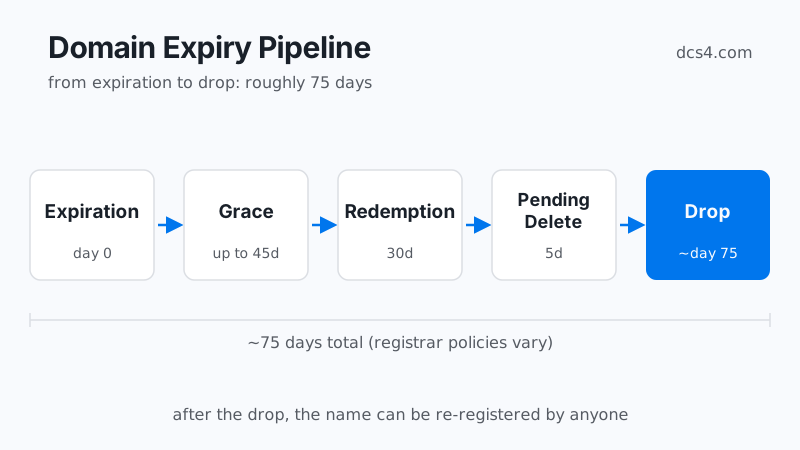
Most quality names are caught by professional drop-catchers, but patient founders monitoring drops do occasionally land a strong name at registration cost.
A practical naming heuristic
If you are naming a startup today, work backwards from usage:
- Will the name be spoken often? Prioritize pronounceability — CVCV-style patterns — and budget accordingly.
- Is it mostly typed and shown on screens? A random 4-letter or 4-character string may be all you need.
- Is this a prototype? Take an available 4-character name now, upgrade the domain when the product earns it.
The premium founders pay for 4-letter domains is not mystique. It is the summed cost of truncation, typos, misheard names, and credibility friction — paid once, upfront, instead of daily for the life of the company.