CVCV and Pronounceable 4-Letter Domains: The Most Brandable Pattern
In the 4-letter domain market, no pattern commands more consistent premiums than CVCV — consonant, vowel, consonant, vowel. Names built on this shape, like nivo.com or sato.com, are pronounceable by design, and pronounceability is the single strongest predictor of what a short .com is worth. Understanding the pattern classes tells you most of what you need to know about LLLL.com pricing.
What CVCV means
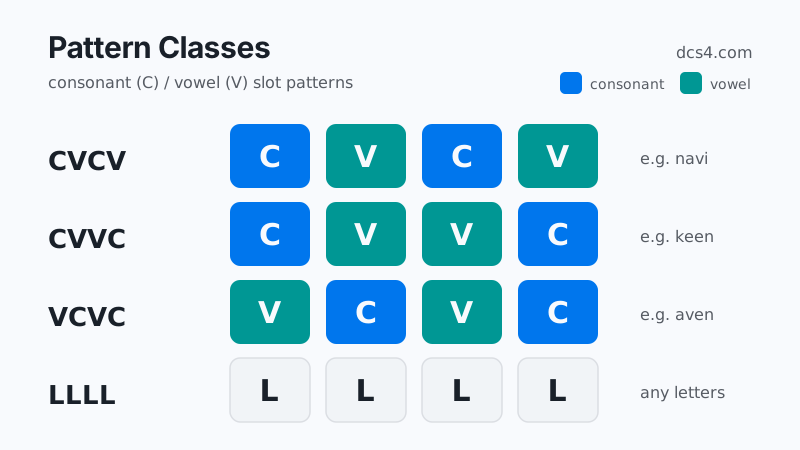
The notation is simple: C stands for a consonant, V for a vowel (a, e, i, o, u). A CVCV domain alternates consonants and vowels, ending on a vowel. That shape mirrors the syllable structure of many languages — Japanese, Italian, Spanish, Hawaiian — which is why CVCV names tend to be pronounceable almost everywhere.
The supply is fixed by the same math as the broader category: 21 consonants × 5 vowels × 21 consonants × 5 vowels = 11,025 CVCV combinations. Out of 456,976 LLLL.com names, barely 2.4% are CVCV. All of them were registered long ago.
The main pattern classes
CVCV is the headline class, but the market recognizes a family of patterns:
- CVCV (
livo.com): the premium standard. Pronounceable, brandable, globally friendly. - VCVC (
edun.com): vowel-led, still pronounceable, slightly less uniform demand. - CVVC / CVCC (
deek.com,lorm.com): often readable as one syllable; value depends heavily on the specific letters. - CCVV / VCCV and other shapes: a mixed bag — some read naturally, most do not.
- Random strings (
zqvx.com): no vowel structure, no pronunciation, valued near the category floor.
A detail worth knowing: the letter y and semi-vowels blur the lines. myla.com reads as CVCV to a human even though a strict classifier might disagree. Buyers price perceived pronounceability, not formal classes.
Why pronounceability commands a premium
The premium is not aesthetic snobbery; it comes from how brands are actually used.
The radio test. A startup name gets spoken — on podcasts, in pitches, in support calls. A CVCV name can be said aloud and typed correctly on the first try. nivo.com survives a car ride conversation; zqvx.com does not. Every failed transcription is a lost customer, so founders rationally pay more for names that pass the test.
Blank-canvas branding. Pronounceable non-words are empty vessels. Nothing comes up when someone searches them, they carry no baggage, and trademark clearance is usually straightforward. This is the same logic behind coined brand names generally — but CVCV gives you the coinage in exactly four letters of .com, the tightest possible package.
Cross-language reach. Because consonant-vowel alternation is nearly universal, a CVCV name rarely collides with an unpronounceable or embarrassing reading in major markets. For companies with international ambitions, that removes a real due-diligence headache.
How much more is a CVCV worth?
Exact prices move with the market, so treat any number as a snapshot rather than a law. But the relative structure is stable: a strong CVCV typically retails for many times the LLLL.com floor, and the best ones — those that double as short words in some language, like sato.com would — reach the highest end-user prices in the category. Meanwhile a random string like zqvx.com sits at or near the floor regardless of market conditions.
The practical takeaway: within the same four-letter length, pattern can matter more than everything else combined. Two domains with identical length, age, and extension can differ in value by two orders of magnitude purely on letter arrangement.
Applying this when browsing available names
You will not find a CVCV at registration fee — the pattern is too well understood, and drop-catching services snap up anything pronounceable within milliseconds. But the framework still helps you judge what does slip through:
- Semi-pronounceable shapes (CVCC, CCVC with friendly letters) occasionally appear on the premium LLLL.com list after a drop.
- Mixed 4-character names in the main index can mimic brandability — a name like
k7q2.comwill never pass the radio test, but one like4bux.comarguably reads aloud fine. - Watching the expiry pipeline matters most for pattern hunters: the best names are contested, and timing is everything.
CVCV is the most brandable pattern because it compresses pronounceability, neutrality, and global readability into four letters. With only 11,025 in existence and every one owned, it is also the clearest example of how pattern — not just length — drives value in the 4-letter market.